






















Certified information security and AI. Your Data secured and Private to you.
Talk with us

CEO & Co-founder
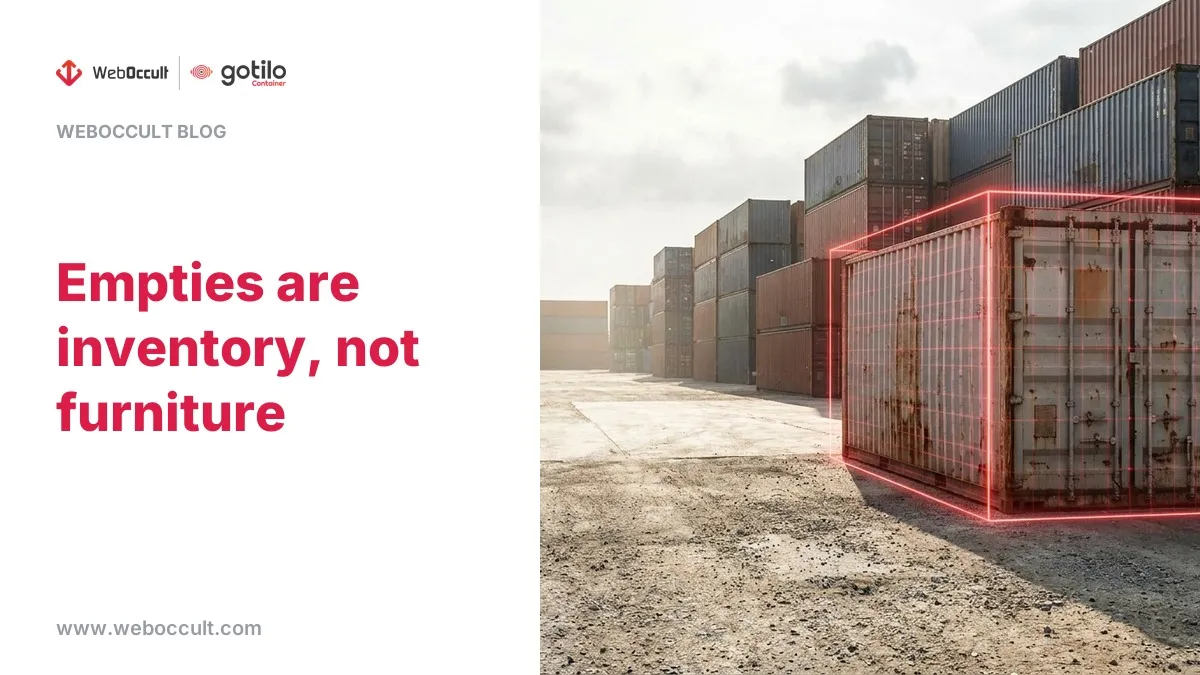
Pravin has run the empty depot for nine years, and he will tell you he knows every box in it. Then he walks you to the far corner, points at a container furred with dust, a small spider web in the corner casting, and goes quiet. It came in months ago. Nobody remembers the booking. The crane works around it. People park beside it. It has, somewhere along the way, stopped being inventory and become part of the scenery.
Every empty yard has one. The trouble is the fifty others, quietly on day sixty, drifting toward the same fate while nobody is counting.
The short answer: empty containers are inventory, not furniture. Good empty container yard management means repositioning empties by age and value rather than proximity, surveying condition on camera at gate-in and gate-out, and flagging forgotten boxes, all of which AI vision automates without new sensors on the box.
Look at an empty yard from above and you see two kinds of emptiness: space waiting for a box, and boxes waiting for cargo. Both look passive. Only one costs you nothing. Empties occupy space, block access to laden boxes, and need their own fuel and labour to reposition. Most yards understand this in principle. Far fewer run as if it were true.

Ask which empty should move first and a well-run yard answers by age, type, owner and what it is blocking. In practice, many yards answer differently: the empty that actually moves is the one nearest the gate, or the one the available crane can reach. Not the oldest, not the most expensive, not the one trapping a higher-value laden box. Just the closest. That is twenty-year-old decision-making running inside a modern operation.
An empty arrives clean on Monday and leaves dented on Thursday. The line says it went out damaged. The yard says it came in fine. The transporter says it was never near it. Everyone is certain. Nobody has a photograph. So it becomes a negotiation settled by whoever argues longest, not whoever is right. Multiply that across every empty in a month. The dent is small. The disagreement is the expensive part, because it has no end.
This is exactly where Gotilo Container works, the empty yard and CFS, deployed gate to ground to gate on vision AI, with no new sensors on a single box.

1. What is empty container yard management?
Tracking, prioritising and surveying empties so they move by age and value, are surveyed for damage at gate-in and gate-out, and are never forgotten in a corner accruing cost.
2. How does camera-based EIR work?
An AI vision EIR photographs each empty at gate-in and gate-out, localises damage automatically, and stores it against the container ID and time, settling disputes with a record.
3. Do we need to fit sensors to each container?
No. The approach uses gate and yard cameras to read and track the boxes, so there is nothing to install on the containers themselves.
How much did your depot spend last month settling damage disputes you could not prove either way, and how many empties are past the point where anyone remembers why? If neither number is at hand, that is the opportunity gotilo.