




















Certified information security and AI. Your Data secured and Private to you.
Talk with us
Perfect the Coat. Eliminate Contamination. Ensure Photolithography Precision.

Photoresist coating is the first critical step in wafer patterning, any variation in film thickness, streaks, or contamination can cause pattern distortion or complete lithography failure. Yet, traditional inline checks or manual inspections often miss these subtle but fatal errors.
AI-powered Resist Coating Uniformity & Defect Monitoring uses computer vision to continuously inspect resist film application in real-time. It tracks film consistency, detects defects like bubbles, streaks, and particles, and identifies non-uniform thickness across the wafer, before the wafer reaches the exposure tool.

Variations across wafer radius or from batch-to-batch can result in uneven exposure or resist development.

Bubbles, streaks, or particles are difficult to catch without consistent high-resolution inspection.

Poor edge bead removal (EBR) or aging resist causes contamination at the wafer edge, reducing usable area.

Defects are often discovered only after exposure or development, too late for correction.

High-speed cameras scan coated wafers for surface anomalies and coating consistency before exposure.

Visual data is processed to detect microns of variation across wafer zones and flag abnormal patterns.

Identifies EBR failures, air bubble entrapments, and inconsistent spin profiles that can compromise quality.

Automatically stops defective wafers from progressing and recommends rework, saving exposure tool cycles.
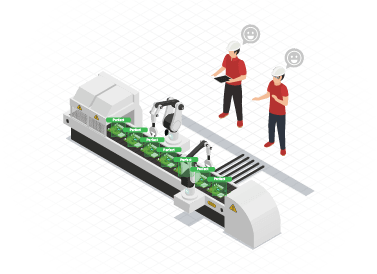
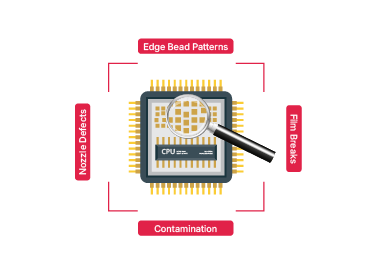

We begin by identifying the optimal inspection point, typically between the spin coater and EBR or before bake, to ensure full visual access before exposure.

Camera and lighting systems are tuned to work across multiple resist chemistries and coating speeds, with configurable profiles for each product line.

Our models are trained using historical coated wafer data, including edge bead patterns, film breaks, nozzle defects, and particulate contamination.

The inspection system sends “pass,” “hold,” or “re-coat” commands directly to your MES system, while simultaneously logging heatmaps and coating stats per wafer ID for traceability.
Stay updated with the trending and most impactful tech insights. Check out the expert analyses, real-world applications, and forward-thinking ideas that shape the future of AI Computer Vision and innovation.

Three months after the incident, the assessor sits across from Meera, the operations manager, and slides a form over the desk. She is ready for questions about helmets, about whether the supervisor was present, about protocol. He asks none of them. He asks one thing instead: show me the footage. Meera’s yard runs safety well. […]

CEO & Co-founder

Deepak runs operations at a mid-size terminal, and one number has bothered him for a month. Two ship-to-shore cranes, side by side. Same model, same year, same maintenance schedule. Crews rotate between them every shift. One averages 22 moves an hour. The other averages 30. He sends a maintenance team over the slow one. They […]
CEO & Co-founder
Pravin has run the empty depot for nine years, and he will tell you he knows every box in it. Then he walks you to the far corner, points at a container furred with dust, a small spider web in the corner casting, and goes quiet. It came in months ago. Nobody remembers the booking. […]
CEO & Co-founder
