






















Certified information security and AI. Your Data secured and Private to you.
Talk with us

CEO & Co-founder
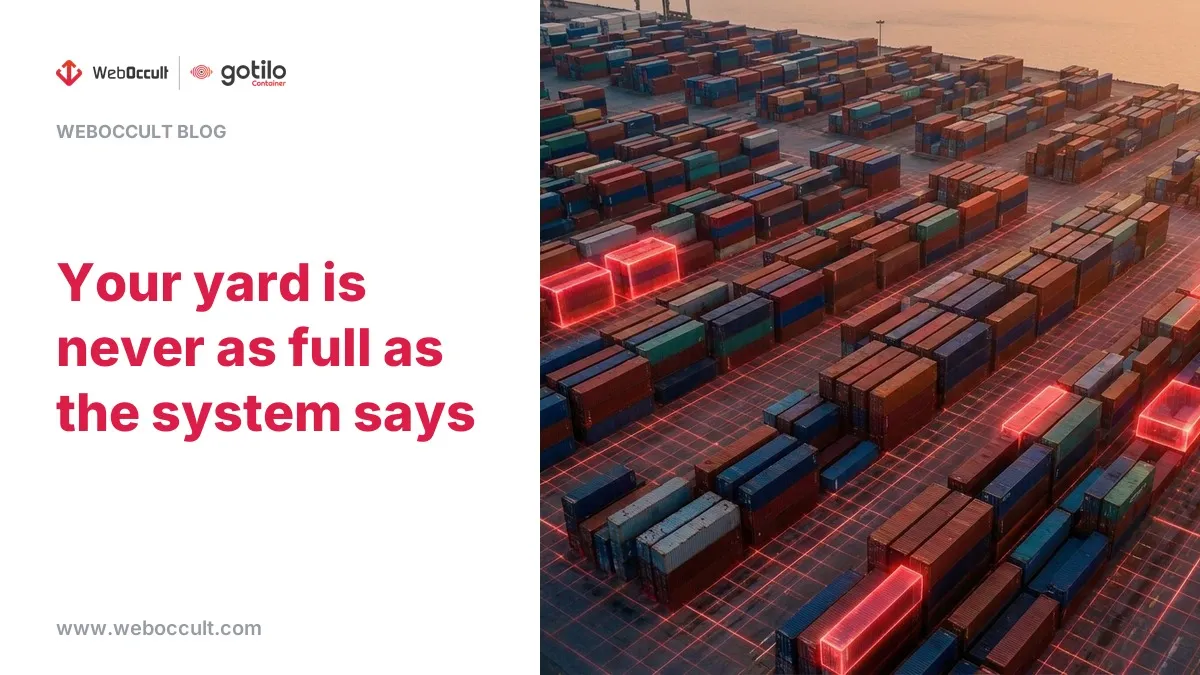
The vessel is twelve hours out and Anjali, the yard manager, is staring at a screen that says the yard is 92 percent full. She has a stack of boxes inbound and nowhere obvious to put them. So she does what experienced managers do under pressure: she books overflow space at the depot down the road, just to be safe.
The next afternoon, a colleague flies a drone over the yard for an unrelated reason. They count from the footage. The real number was 78.
Anjali did not make a mistake. She made a sound decision on a number that was quietly wrong. And she paid for overflow she never needed.
The short answer: most yards run 10 to 15 percent below the occupancy their system reports, because of “phantom slots.” AI vision fixes yard occupancy accuracy by continuously reconciling the live yard against the YMS, so the map and the ground tell the same story when it matters.

Nobody creates the gap on purpose. It accumulates, one ordinary event at a time:
Each is minor in the moment. Together, by midweek, the screen and the yard have stopped agreeing.
It sounds like a data hygiene issue. It behaves like a financial one.
When the system says you are nearly full, you turn away boxes you could have held, or you rent overflow you did not need, exactly Anjali’s Tuesday. You plan labour and equipment against a picture that is already stale. You promise a slot that is taken, or refuse one that is free. The cost is not the inaccurate number. It is the chain of confident decisions built on top of it.
A yard runs on two truths: what the system says, and what is actually on the ground. Visibility keeps them in agreement.
AI vision watches the yard continuously, using cameras already in place or modest additions, and reconciles that live picture against the YMS. It flags the divergences: the slot the system thinks is full but is empty, the box logged in the wrong row, the move that was never recorded. The output is not a prettier dashboard. It is a yard map you can trust when a ship is inbound and the decision cannot wait.

1. What is yard occupancy accuracy?
It is how closely your system’s view of which slots are full matches the ground. A 10 to 15 percent gap is common and quietly distorts capacity, billing and vessel planning.
2. Why does my YMS show the yard fuller than it is?
Boxes that leave but are never closed out, containers logged in the wrong row, and moves that never reach the screen create phantom slots that accumulate over time.
3. How quickly can we measure our own gap?
Pick one block, ask the system how many slots are occupied, then go and count. The difference is your phantom-slot problem, measured for free in ten minutes.
Try that count tomorrow. If the two numbers match, you are in rare company. If they do not, you have just found capacity you are already paying for gotilo.